Flat Earth
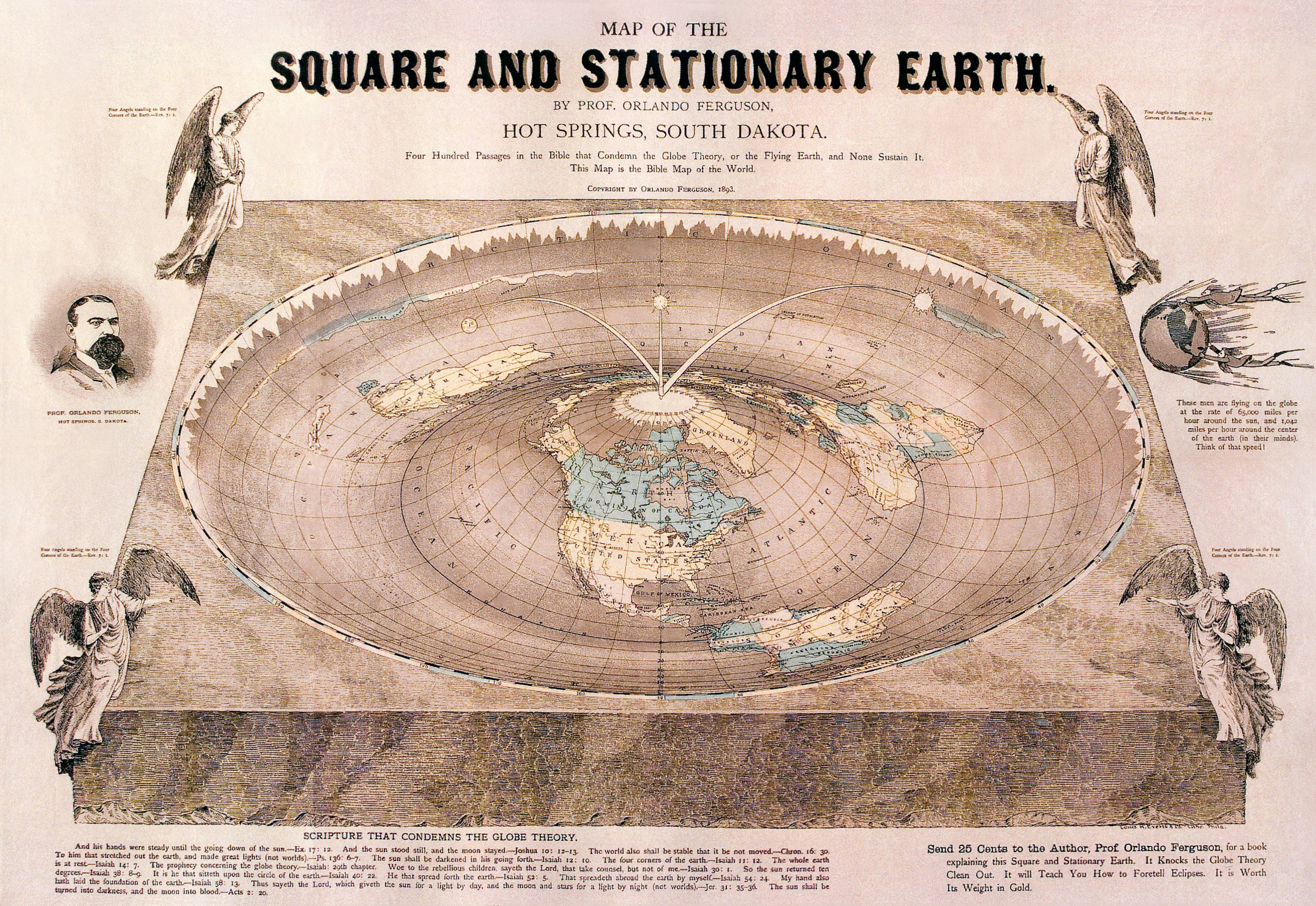
I'm a psychologist. I love crazy like Marie Kondo loves mess. So I've been listening to Flat Earth videos to help with my insomnia at night. And I've been finding it extremely interesting. It's the kind of thing, well, like all of these conspiracy theories, that show why humanity switched from philosophical concepts like logic and reasoning, to the scientific method, because obviously you can logic your way into anything. And they have logiced their way into an entire fantasy world with a consistent and imaginative entire worldbuilding structure.
I didn't know that, and I don't think a lot of other people do either. Before I started listening to these videos I was imagining a flat Earth, floating in space, next to the other planets. That's not the case. There is no "outer space", like, core concept.
As a psychologist, I don't believe that the vast majority of people within the flat earth community actually believe any of it. I think that it's functioning as a thought experiment specifically for the worldbuilding exercise, to build a logically functioning world. I think that attributing belief to these people is 1: A mistake and perhaps disingenuous, and 2: A barrier to learning about the actual creative worldbuilding, which is a disservice to yourself if you like that kind of thing.
So, there are a few different Flat Earth cosmologies, and I'll be talking about the one I'm most familiar with, which borrows from ancient mythology, with a big emphasis on biblical or abrahamic mythology.
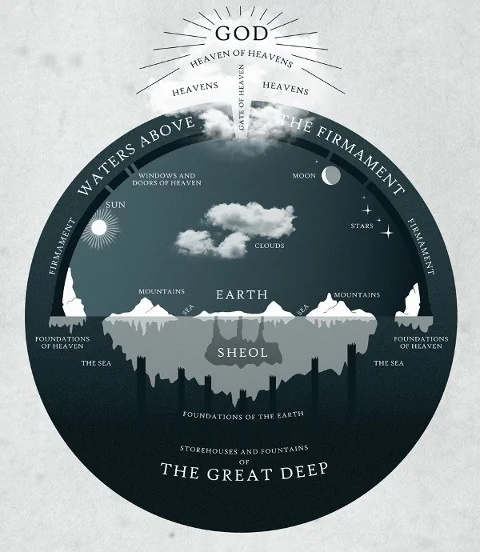
So, the first thing I'm going to need you to do to understand what we're talking about is to throw out the entire core concept of space. You're going to have to suspend your disbelief here. Earth is literally all there is. There are no other planets. There are no stars as we understand them. There is no gravity.
The entirety of the planet is laid out on a flat plane, with the North Pole in the center, and Antarctica on the outer edges. It's a big, flat circle. The sky terminates not in an atmosphere, but in an actual solid physical barrier called the firmament. The composition of the firmament is a point of debate, but it seems to have the consistency of glass, and is transparent, allowing people to see through it. It's attached to an "ice wall", which is what the continent of Antarctica is, it's the place that the firmament dome attaches to the planet. And this is important, because of what lies beyond the firmament.
The firmament exists to keep out what is called, "the waters above". The earth is surrounded by a vast quantity of water, and if the firmament is breached or open, these waters rush in and flood the planet. This is what happened during Noah's flood. The entire planet is a terrarium inside an ocean. Therefore, humanity cannot breach the firmament, because it would destroy the world in a horrific flood, which has happened before. So there's no space, just water.
The concept of gravity is also just not a thing, much like outer space. It does not exist. All physics is based on basic laws of density. So things that are denser fall, things that are lighter rise. Now, you might be asking yourself, then wouldn't a terrarium full of gasses float to the top of the waters above instead of being submerged in it, and I'm going to need you to mind your business because if you keep asking questions it's not going to make any sense. None of this holds up to even minute amounts of scrutiny. That's not what we're doing here.

So if there's no space, what are we looking at when we look up at the sky?
So what we think of as various celestial bodies are called, "luminaries". Because they're luminous. So let's tackle the stars first, because it's a lot easier to wrap your head around. So at the North Pole, which you'll remember is the center of the world, there's the north star, Polaris. So how this works is that the planet doesn't rotate, the sky does. Polaris is essentially a maypole or the fulcrum, on which the rest of the stars (which are lights, remember that these are not actual stars, just lights) spin. It's similar to a video game skybox. What exactly they are is, once again, a point of debate, but the easiest way to think of it is that the "fixed stars" are on a rotating path around polaris.
So what about the planets that you can see from Earth? Like Venus and whatnot? Those are called, "wandering stars". And their paths aren't caused by perspective, but rather they're also lights on set paths moving across the sky. These paths are likely created by whatever deity or creators made the terrarium. When a wandering star goes into retrograde, it's supposed to do that. It might even be like that on purpose to help with various mythological powers, such as foretelling the future.
So why don't they look the same from everywhere? Why are the paths completely different in the southern and northern hemispheres if it's just a skybox? Again, not what we're doing here. Mind your business. Don't worry about the other hemisphere. That's not your business.
None of this works in the southern hemisphere. If you're from Australia or Argentina or wherever, this is just not going to work and I'm going to need you to accept that whole cloth. You got soccer, you'll be fine.
So back to polaris. Think of it like a maypole in order to understand how the sun and moon work. The moon is weird. Settle in. The sun and moon are both rotating around polaris, but not like the stars, but like maypole dancers on a ribbon, so they start out farther out, then move in a spiral closer in, then out in the spiral again. The sun moves slower than the moon. They are both the same size, and the same distance away, which is around 3,000 miles.
They produce localized light, like a spotlight or flashlight beam. And yes, "they". The moon produces its own light, not reflecting sunlight. They're also both disks of plasma or something, so the moon isn't made of rock, it's similar to the sun or stars. And, apparently the way we think of light is also wrong, because moonlight is cold, so light doesn't give off heat. The sunlight is hot and the moonlight is cold. They're out here putting thermometers in direct moonlight and shade and shit. No accounting for confounding variables or any of that shit, that just slows you down. Don't worry about it.
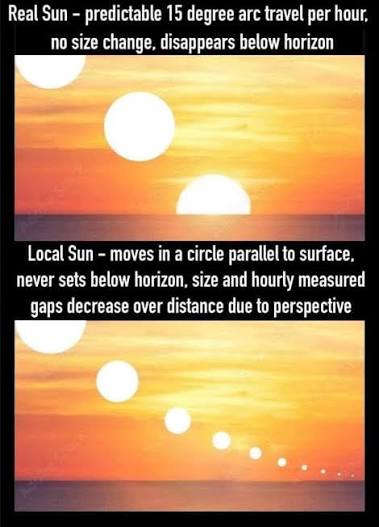
So, if the sun is a spotlight and the planet is a flat disk, why can't I see the spotlight? Because the planet is still a big ass planet. Like big as shit. So the answer is perspective. It just eventually gets so small you can't see it. It's literally only 32 miles in diameter. Whereas the diameter of the flat earth is 25,000 miles. So as it leaves it just gets smaller and smaller until you can't see it anymore, like instead of setting. It just gets smaller until it hits the horizon on your sightline.
"But I've been on this planet my whole life and I've never seen the sun or moon change apparent size,". Yeah, well, again, not what we're doing here. Observation is bad. Science is a myth. Calm down and play in the space.
So how do the phases of the moons work? It just does that. It's a light, and occasionally some of it turns off. Lights can do that. They make moon lamps that do that. It does that in a cycle because it does. That's just how the moon works.
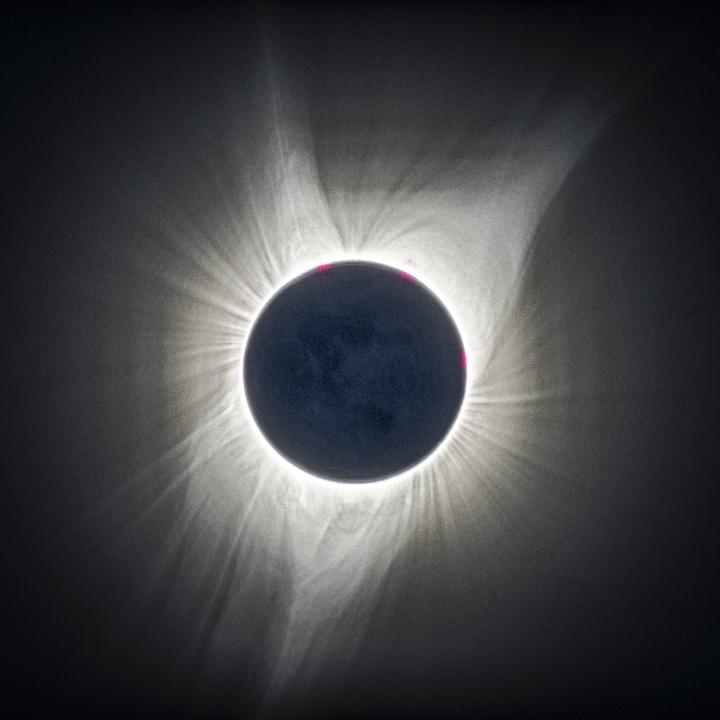
What about eclipses?
This one is really good. I love this one. So I'm going to introduce you to the brand new concept of "The Dark Sun". This is another object in the sky, but unlike all the other ones that glow, it's literally just kind of there. It's a third thing like the sun and moon, and it's also moving around the maypole that is polaris, but it doesn't light up. So sometimes, it blocks the sun or moon. Aside from that, it's just not visible against the darkness, because it's black and doesn't glow.
Then wouldn't we see it approaching when it gets in the sun's spotlight, as a circle the same size as the sun, instead of looking like a shadow? And I swear to god if you have one more sentient thought you will fuck up the whole thing.
My insomnia has taught me a great many things, and I love these alternate reality speculations. But this one does have a very melancholy feel to it. It's got everybody trapped in a terrarium in a vast, unknowable ocean, and any attempt at escape would just destroy the entirety of the known world. This is a completely different mindset than what humans seem to have naturally, which is curiosity and exploration. There's a lot of speculation about what's beyond the ice wall where the firmament attaches to the planet, but there's no way to ever know because you can never, ever leave. Because it's not just an atmosphere that you can blast through in a spaceship, it's an actual physical barrier, the destruction of which would let those waters above in. So it makes humans a lot less capable and gives an overall sense of hopelessness that I just don't know like... why you would need? That's just not who we are as a species. We'll go to the moon in this decade, not because it's easy, but because it's hard. We'll send off probes and call them, "Discovery," and "Messenger" and "Voyager". So it's strange to see a group of humans come up with an entire cosmology that traps a species known for exploration. So it's incredibly interesting, but has an aura of unnecessary sadness.

