The Legend of Zelda:
Minish Cap
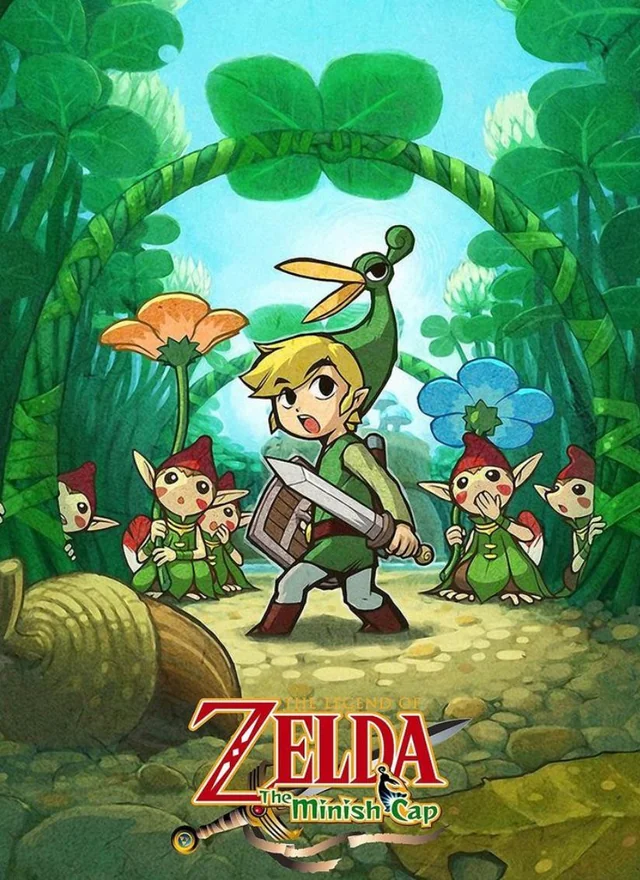
Thank god, finally, some fucking whimsy. I recently made myself beat BOTW because I refuse to just not beat a Zelda game, but goddamn did that horrific ordeal take a lot out of my body and soul. So I wanted to play a real, you know, good, Zelda game, to get the taste of that godawful tech demo out of my mouth. Therefore, this review is likely to be tainted just by the sheer proximity to BOTW. It doesn't take much to look good standing next to that. Things like, "has basic game design," or "has a plot" look exemplary when you've been denied them for an entire playthrough of a product.
I played through this game on my Switch 2, which had one very big difference from my older playthroughs on the GBA; the save states. This wound up being a huge quality of life difference that I used far more than I thought I would. I had been primed to go this route because of a game breaking glitch I encountered on my original switch when playing Paper Mario, but it really is a faster way to get back into the game, which is not necessary, but once you're grown and have to work in the morning, it is nice to save those 4 microseconds or whatever.
.webp)
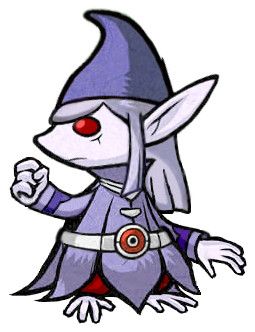
So one of the many good things about having an actual plot, is that your story can have actual meaning as a piece of art beyond what is just explicitly stated. For example, the villain of Minish Cap is the concept of internalized racism. Vaati is a fan favorite Zelda villain who was not in Hyrule Warriors and everyone was upset about it. But his whole thing is that he was a Minish, a creature that is not a Hylian, but which is an objectively cool kind of creature to be. But he doesn't think so and spends the entire game masquerading as a Hylian using magic that he learned from his master Ezlo and trying to use the Light Force to gain ultimate magic power, with no stated goal beyond that. But the subtext is that he wants to be seen, to be respected, to be, essentially, Hylian.
The Hylians at this point after the colonization of the surface are the ruling species of Hyrule. The Minish, by contrast, are tiny creatures that most Hylians can't even see, who, nonetheless, often go to great lengths to help the Hylians. It's the Minish who leave the rupees and arrows and hearts and whatnot in bushes and grass, for example, and it always has been.
Like every people, they have a vast variety of skills and careers, from great mages to scholars to blacksmiths, and a thriving society in their own right. And thank god. Because after the recycled textures on the giant map of BOTW I felt the tension leave my shoulders the first time I stepped into these beautiful, tiny towns made of pots and shoes, just areas of actual creativity and whimsy, rendered beautifully. The GBA had a lot of gorgeous games, the available color palette made for some stunning environments, but the sheer contrast between wandering through a world I could see off my back porch on BOTW to shrinking down and entering a tiny town full of fantasy creatures, you know, like one would do in a fantasy game, breathed life back into my soul.

Look at that! That's a tiny house for a tiny creature made from a discarded shoe! It's so creative and whimsical and beautiful! They have a mushroom garden on their roof!
Shrinking down and walking in Minish Woods really did have an actual, somatic effect on my body after the ordeal of BOTW. I knew, in that instant, that I was playing a video game. That I was going to have fun. That someone sat down and designed these environments, and made sure that they made sense in the greater world that they had designed. I knew that I was looking at and interacting with something that wanted me there. You know, this is a portable game. But unlike BOTW, it doesn't feel like it wants you to dick around in a field for 10 minutes while you're watching YouTube videos in the background. This is a world, a world where there are real people, a world where there are real designs, a world where there are real stakes. A world where these people designed their living quarters and areas of commerce in ways that actually make sense so that a player doesn't get lost.

The map on this game is expertly laid out, and is actually readable. As in the text isn't tiny, and the area is a manageable size that a human can actually learn via kinesthetic intelligence. You know where you are in this game. I didn't get lost once. The in-game map is broken into sections, and selecting a section brings up a more detailed map of that particular section. These sections are marked with important things you have unlocked (normally via Kinstone fusing) so that you don't forget your progress between play sessions. This is great for people who have busy schedules, such as adults like me who work full time and have family obligations, or just anybody who can't make a video game their main priority because they are sane.
And yet, even with a perfect map, even with perfect navigation, I'm just out here going about my business and who do I see?

Well, I'll be goddamned, if it ain't my good friend, Tingle. Kooloo-Limpah! The map's actually fine this time around, buddy, what are you doing here? Turns out, he's just here to fuse Kinstones to help you get a special item with his siblings. What a delightful surprise! So here we have Tingle, in a game that arguably didn't even need him, but in BOTW we don't have Tingle, when a cartographer was so desperately needed that fans had to band together and make an interactive map just to find the shrines, because the game refused to, you know, work as a video game.
I really was surprised to see him, too. I had forgotten he was in this game, because the map was so good so he didn't serve an immediate, obvious purpose. I mean, I do like being able to control the boomerang, but he is literally just here to be whimsical and helpful. I was just walking by and he was sitting up there and I was like, "Oh, it's my good friend Tingle, he probably wants money," but he didn't. Just a good experience all around.

Which is a good segue into Kinstone Fusion. This is a game mechanic where you can open up new areas, spawn chests, and really do a variety of things, by going up to people and, if they have a little bubble appear like the one you saw on Tingle up there, hitting the L button and fusing your Kinstone piece with theirs. Very few of them are mandatory, they're mostly just extra, though some are very useful, like the Tingle Brothers' boomerang upgrade I mentioned earlier. It's just a fun, functional little mechanic that gives completionists something to do aside from the main story. It breathes life into the world.

The main content is dungeons. Actual, real dungeons. The kind with enemies and puzzles and maps. The kind that give you an item, and then are designed around teaching you how to use that item, so you then know how to use that item. The kind where you finish a puzzle and it causes stuff to happen in other areas of the dungeon, because this is a real world where causal reality exists.
Beating a dungeon and getting the MacGuffin has the tangible benefit of letting you use that MacGuffin to upgrade your sword. You start with the Picori Blade and you are working towards the Four Sword. Each upgrade as the game progresses allows you to create a new magical clone that perfectly mirrors your movements. This allows you to interact with the world in new ways and do things you couldn't before, like hitting certain switches or moving heavier objects.
That means that every single dungeon gives you new, tangible benefits that exist outside that dungeon and affect your life in the wider game world. You have the new clone, and you have the new item. And you can experiment in the wider game world to change it and do more things. I know this is basic game design, but I played BOTW and I hunger for competency.

For example, there are a bunch of these giant unbreakable pots scattered around. Originally, you can just get in them and kind of be in them, which has no real benefit to you. But you see these multiple, giant, unbreakable pots, and you think, "Well, I'm playing a video game, so these mean something. These are supposed to do something." Then, you get an item, the Cane of Pacci, which flips stuff over. So you hit those giant pots, and they flip over to reveal that you can use them in conjunction with Ezlo's magic to shrink down to Minish size, so you can explore that same area, but tiny. You can now fit into spaces that you couldn't as a Hylian.
Everything is interconnected, creating a sense of immersion. The world feels real in a way that BOTW doesn't, and genuinely can't, because it's designed so poorly. Areas reward the player for coming back and exploring with new items and abilities.

Ezlo, the companion in this game, might be my favorite Zelda companion of all time so far. Ezlo is an old man telling it like it is. He was a Minish sorcerer, but Vaati (who is his apprentice) stole a magical item he made, a hat that grants wishes, and turned Ezlo himself into a hat, just prior to the events of the game. Ezlo can still cast some of his magic, and mostly uses it to help you change between Hylian and Minish sizes. But his overall Abe Simpson like attitude and personality are why I love him so much. Every Zelda fan loves a good Old Man NPC, but Ezlo is so much more than that trope. Plus, I really feel like we need more accurate old people in video games just in general. Ezlo is a wise wizard, but he's not the stoic archetype, he's a person.
Overall, this is just a great game. I actually can't really think of any complaints. It was a delight from start to finish. And, if you have a Switch 2, it's part of the subscription service, which isn't that expensive and you do get a lot with it. But if you don't have a Switch or Switch 2, I'm sure you can find it for free, GBA games aren't that hard to emulate. Overall, I heartily recommend it!

